
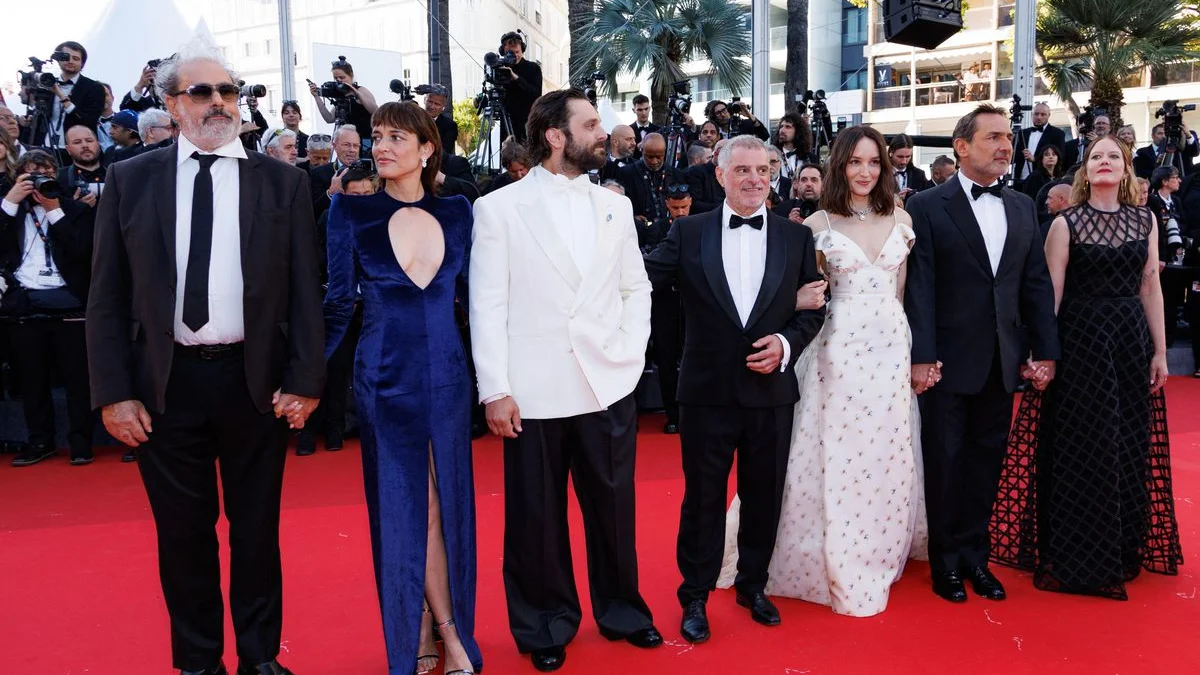
The Festival initially advertised more than 950 participating cinemas for the operation organized with the Fédération Nationale des Cinémas Français, France Télévisions and Brut. Its mid-festival figures later put the final footprint above 980 venues.
Those theaters carried the opening ceremony live at 7 p.m. and then screened Salvadori's movie. Cannes says the combined cinema event brought in more than 52,000 spectators on the first night.
The premiere was also the release date
Diaphana Distribution dated the French theatrical release for May 12, the same Tuesday as the Cannes premiere. The decision matters because the festival appearance was not functioning as a long-lead publicity stop before an unrelated commercial opening.
The red carpet, ceremony and theatrical launch were one event.
France 2 added another layer. Cannes reports 1.75 million television viewers for the opening ceremony, while moviegoers in participating theaters could watch the same broadcast and remain for the feature afterward.
A festival stage became part of the exhibition package
There is nothing new about cinemas holding previews around a festival. The scale and synchronization are the useful parts here. Nearly a thousand venues could sell a night that began with Cannes itself rather than simply advertising an early screening of a movie that happened to be on the Croisette.
That gave exhibitors something they regularly ask event cinema to provide: a reason for the exact time and place of a screening to matter.
It also gave Diaphana access to a media event no independent distributor could manufacture on its own. Opening-night footage of Pio Marmaï, Anaïs Demoustier, Gilles Lellouche, Vimala Pons, Gustave Kervern and Madeleine Baudot was already part of the evening the audience had bought.
The movie itself is considerably smaller than the rollout
The Electric Kiss is a 122-minute romantic comedy set in Paris in 1928, Salvadori's first period feature and his eleventh film across 34 years.
Its premise is built on deception rather than spectacle. A grieving painter attempts to contact his dead wife through a psychic. The woman answering him is actually a carnival worker who entered the fortune teller's trailer looking for food and discovers she can sustain the fraud.
Benjamin Charbit, Benoît Graffin and Salvadori wrote the screenplay from an original idea by Rebecca Zlotowski and Robin Campillo. Les Films Pelléas produced, with Julien Poupard as cinematographer and Camille Bazbaz composing the score.
The first night was large enough to appear in the eventual box-office story
CBO figures carried by AlloCiné put the film at 326,203 admissions by May 20. That total includes the unusually large opening-night event rather than beginning with a conventional Wednesday launch.
The result does not prove that Cannes can add 52,000 admissions to any French release. An opening film receives publicity, television attention and access that cannot be scaled across the weekly distribution calendar.
What the experiment demonstrated is narrower and more practical. A festival premiere does not have to create a delay between the people photographed seeing a movie and the people paying to see it. On May 12, those audiences were watching at the same time.